Living in Valencia: what Spain's most talked-about city is actually like in 2026
Plain Spain editorial team · · 10 min read
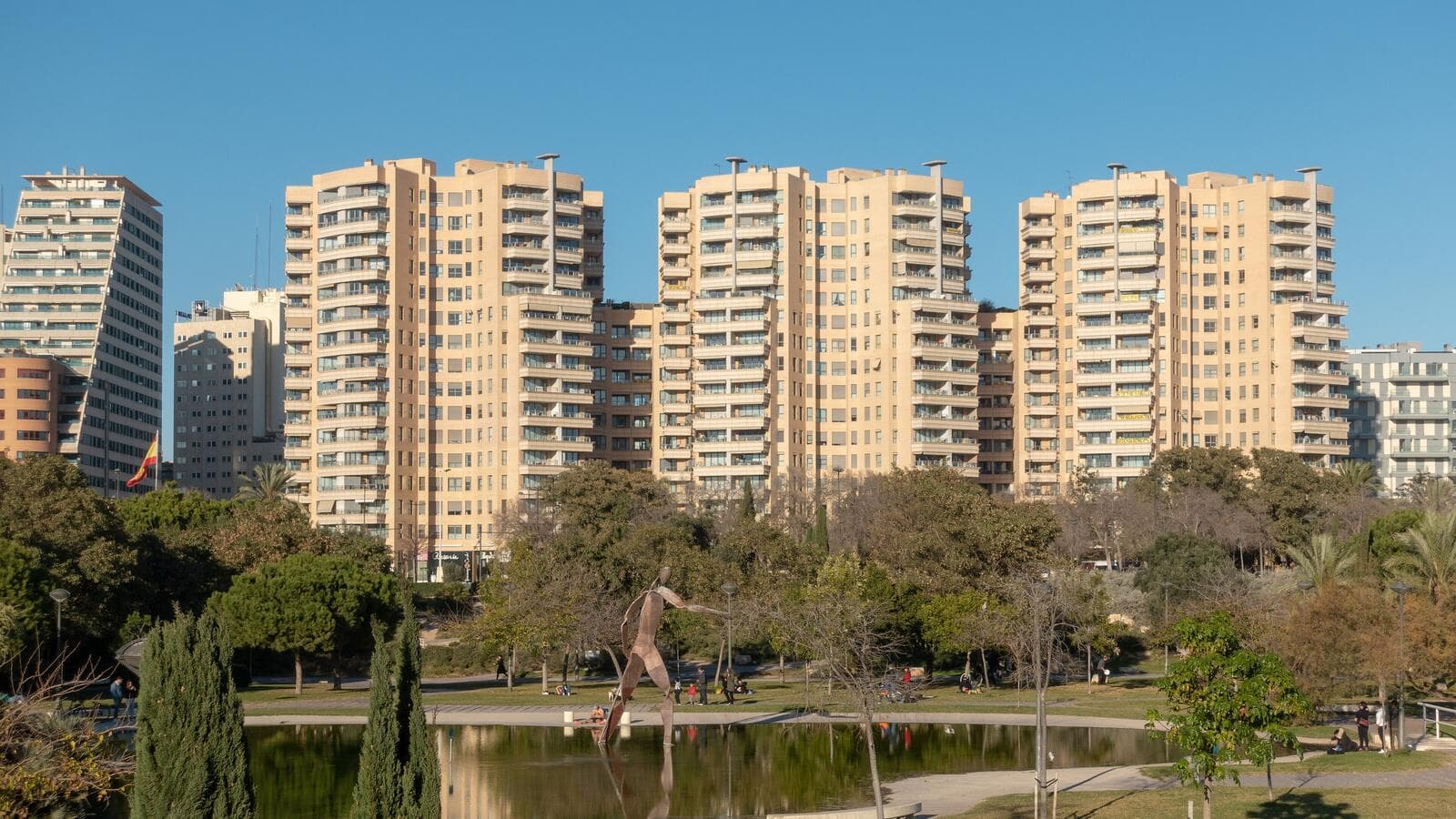
Photograph: Kent Wang, via Wikimedia Commons, licensed under CC BY-SA 2.0. Original file.

Valencia is a flat, walkable Mediterranean city of around 800,000 people, with a nine-kilometre park where its river used to be, a beach inside the city limits, and an airport twenty-odd minutes from the centre by metro. Daily life happens outdoors for most of the year. The trade-offs are real: three genuinely difficult summer months, a rental market that has tightened hard since the pandemic, and a metropolitan area still repairing damage from the 2024 flood. This is what a full year here actually contains, including the parts the city's press coverage in 2026 has skipped.
Why is everyone talking about Valencia in 2026?Link to this section
Three unrelated things put it in front of you this year: a total solar eclipse in August, the Gay Games at the start of the summer, and a Sorolla collection arriving from New York.
On 12 August 2026 the moon's shadow crossed Spain from west to east, and Valencia sat under it. Totality arrived at about 20:32 local time and lasted roughly a minute, with the sun only a few degrees above the western horizon. It was the first total solar eclipse visible from mainland Spain since 1905, and the city spent the evening on rooftops, in the Turia and on the beach. If you missed it, Spain gets two more: 2 August 2027 across Andalusia, and an annular one in 2028. We wrote up what the 2026 eclipse looked like here and how to plan for the 2027 one.
Six weeks earlier, from 27 June to 4 July, Valencia hosted the twelfth Gay Games. More than seven thousand people registered across thirty-nine sports, from marathon to chess, and the city ran a parallel cultural programme in the Palau de les Arts and the old town. It was the largest international event Valencia has staged since the America's Cup years.
And the museum map is being redrawn. The Hispanic Society of America has made Valencia its first venue outside New York, bringing more than two hundred works by Joaquín Sorolla, the Valencian painter of Mediterranean light. The permanent home is the Palacio de las Comunicaciones on the town-hall square, which is still being refurbished; the collection's temporary home is the Museu de la Ciutat. A separate space for the sculptor Manolo Valdés is being fitted out through 2026 with an opening announced for 2027. Check the status of both before you build a weekend around them.
None of it is a reason to move anywhere. It does explain why you keep reading about this city.
What is the weather in Valencia actually like?Link to this section
Roughly eight excellent months, two that are mild outdoors and cold indoors, and an August most residents leave.
Valencia's reputation is built on those eight months. October through to early December is the best stretch of the year: warm enough for the beach on the good days, cool enough to walk everywhere, and the light is extraordinary. January and February are mild by northern European standards and cold by Spanish coastal ones, meaning ten to seventeen degrees, no central heating in most older flats, and a fortnight where your flat feels colder than the street. March through June is close to perfect.
Then there is August. Daytime temperatures sit in the low to mid thirties, the humidity comes off the sea, and the nights do not cool down the way they do inland. Locals leave. Shops shut for a fortnight. If you are choosing a flat, the single most useful question you can ask is which way it faces and whether it has air conditioning, because a west-facing top floor in Ruzafa in August is a different city from a north-facing second floor two streets away.
The other weather event to understand is the gota fría or DANA, the autumn cut-off low that can drop months of rain in hours. It is a normal feature of this coast, and it is the reason the Turia riverbed is a park.
What did the 2024 flood change?Link to this section
Not the city itself, which was largely spared, but the towns and the transport south and west of it, where two years on the recovery is still uneven.
On 29 October 2024 a DANA over the Poyo ravine sent a flash flood through the towns south and west of the city. More than two hundred people died, most of them in Paiporta, Picanya, Catarroja, Massanassa and Alfafar. The city of Valencia itself was largely spared, for a reason worth knowing: after the 1957 flood that put three-quarters of the city under water, the state diverted the Turia around the south of the city, in works completed in 1969. The empty channel became the linear park you will walk in every week, after a residents' campaign in the 1980s beat a proposal to run a motorway down it.
Two years on, the recovery is uneven, and it matters if you are choosing where to live in the metropolitan area rather than the city proper. Metrovalencia's southern network was wrecked, with the Paiporta and Picanya stations destroyed and nineteen trains damaged; the full southern section reopened on 27 June 2025, and metro and tram traffic has since returned to normal. The commuter rail has not recovered as cleanly. The C-3 line towards Requena and Utiel is still not running west of Buñol, with replacement buses in its place and no restoration date announced. If a town in the comarcas south or west of Valencia is on your shortlist, ask specifically what its transport looks like today rather than what the map shows.
In the city itself, daily life shows no trace of any of this. Fifteen minutes away, on some streets, it is still the first thing you notice.
Do you need a car to live in Valencia?Link to this section
No, and most people here do not have one.
Metrovalencia runs ten lines and around 148 stations, mixing underground metro with street trams. Lines 3 and 5 both reach the airport at Manises, which puts a European flight roughly half an hour from the city centre door to door, and Valencia's airport serves around a hundred non-stop destinations across thirty countries. Trams 4 and 6 run out to the Cabanyal and the beach. Line 10, the newest, runs south-east from the centre towards the marina and Natzaret.
The bicycle is the real transport story. The city is almost entirely flat, the Turia park cuts across it end to end with no traffic on it, and the bike lane network has grown to the point where cycling is the fastest way to cross the centre. Valencia was named European Green Capital in 2024, and cycling is the part of that you feel daily.
For the rest of Spain: the AVE reaches Madrid in a little over an hour and a half. Barcelona is about three hours by train. Commuter trains along the coast and inland open up most of the province, which is a whole set of day trips worth doing before you commit to a neighbourhood.
Can you find work in Valencia?Link to this section
If you bring your income with you, easily. If you need a local salary paid in English, much less easily.
Valencia has spent five years turning into one of Europe's default remote-work cities, and the infrastructure has caught up: fibre is cheap and near-universal, coworking spaces cluster in Ruzafa, El Carmen and around the Marina, and English is the working language of a large slice of the tech and startup scene.
The local job market is a different proposition. Salaries in the Valencian Community sit below Madrid and Barcelona, and outside tourism, logistics, agri-food and a small technology sector, hiring in English is thin. Most people who move here without an existing income are surprised by this.
That split is exactly why the visa question matters before the city question. If your income comes from outside Spain and follows you, Spain's Digital Nomad Visa exists for precisely that arrangement, and it is the route most remote workers who land in Valencia use. If your income is passive rather than earned, the Non-Lucrative route is the other door. Which one fits is a question about your money, not about the city.
Do you need Valencian as well as Spanish?Link to this section
For daily life, no: Spanish is what you need, and nobody will refuse to speak it to you. For a school place, the answer changes with a vote.
Valencia is officially bilingual. Valencian, which is the local variety of Catalan, shares official status with Spanish. In practice the city of Valencia leans Spanish in the street and Valencian in institutions, signage and the surrounding towns. Nobody will refuse to speak Spanish to you.
Where it becomes a decision is schooling. Under a 2024 education law, each state and state-funded school now holds a family vote on the main language of instruction, year group by year group. In the first round for the 2025-26 school year, families in the city of Valencia chose Spanish by more than sixty per cent, while across the wider Valencian Community the result was almost exactly even. If you are moving with children, the language of instruction at a given school is a live question with a local answer, and it changes with the vote.
For adults, Spanish is what you need. Valencian is what makes people warm to you, and a hundred words of it goes a long way in Benimaclet or the Cabanyal.
What does it cost to live in Valencia?Link to this section
Meaningfully less than Madrid or Barcelona, no longer cheap by Spanish standards, and a large step down from northern Europe or North America at about the same standard of living. No honest guide gives you a single monthly number, because the number depends on the flat and the flat depends on the month you signed.
| Compared with | Where Valencia sits | Where you feel it |
|---|---|---|
| Madrid and Barcelona | Meaningfully cheaper | Widest in rent, narrowest in the supermarket |
| The rest of Spain | Mid-priced, having moved off a bargain in about five years | Anyone quoting 2019 rents is quoting a market that no longer exists |
| Northern Europe and North America | A large step down at roughly the same standard of living | It is the whole reason the city appears on relocation lists |
Eating out is the line item that surprises people most pleasantly. A weekday menú del día remains one of the best-value meals in Europe, and the Valencian version of it is genuinely good rather than merely cheap. Utilities go the other way. Electricity here is expensive, and a badly insulated flat in August will show you exactly how expensive.
Healthcare is the quiet argument for Spain generally. Public provision in the Valencian Community is good and the private market is inexpensive by international standards, which is why most newcomers end up holding private cover as well, and why a residence application will ask you to prove you have it.
The catchLink to this section
Housing. Valencia's rental market has tightened faster than almost anywhere in Spain, driven by remote workers, tourist flats and a construction pipeline that never recovered from 2008. The neighbourhoods foreigners hear about first are the ones that have risen most. Long-term flats in the centre go quickly, often in a day, and agencies expect a stack of documents on the spot. Come with paperwork ready and a plan to look in person, because remote flat-hunting in this market mostly wastes money.
Tourist pressure is the second catch and it is concentrated. Ciutat Vella and the beachfront take the load; walk fifteen minutes inland and the city is residential again. It is nowhere near Barcelona's situation, but the direction of travel is the same, and locals talk about it.
Third, bureaucracy. Getting an appointment for a residence card, a padrón registration or a tax number involves a booking system that is frequently full. It resolves, but it takes weeks longer than anyone expects and it is nobody's favourite month.
Who does Valencia actually suit?Link to this section
People who bring their income with them, want a real Spanish city at a size they can learn in a month, will use the outdoors most of the year, and would rather be somewhere that still functions for the people who live there than somewhere famous.
Families do well here. The city is safe and flat, and the schools and health centres are good.
It fits less well if you need a large English-speaking professional job market, if you are moving for nightlife on a Madrid or Barcelona scale, if August heat is a health problem for you, or if you want a big-city cultural calendar every week of the year. On that last point, Valencia has raised its game considerably, but it is not Madrid and it does not pretend to be.
If you are weighing it against the obvious alternative, we have compared them side by side in Valencia or Barcelona. If you have already decided on the city, the next decision is the harder one: eight neighbourhoods, honestly compared. And if you are still at the scouting stage, what to actually see here is written for exactly that trip.
Staying longer than a tourist stamp allows means picking a visa route before you pick a flat. Our free eligibility check takes about a minute and tells you which of the two routes your situation fits, or that neither does.