Spain's eclipse run: what August 2026 looked like from Valencia, and how to plan for 2 August 2027
Plain Spain editorial team · · 6 min read
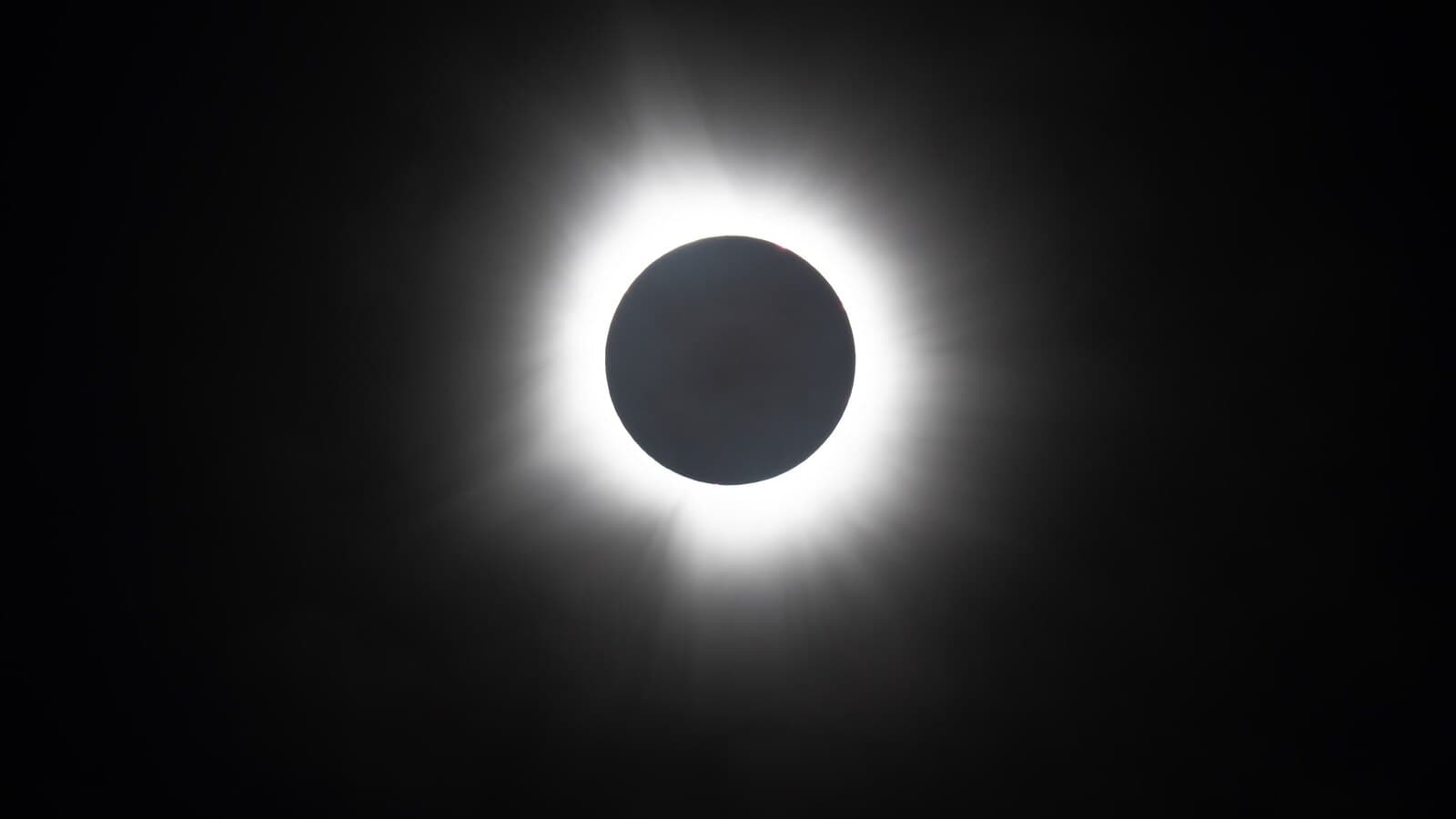
Photograph: Joseph Gage from Yorkville, IL, USA, via Wikimedia Commons, licensed under CC BY-SA 2.0. Original file.
.jpg)
The one worth planning around is 2 August 2027, and the place to plan for is the Strait of Gibraltar. Totality that morning runs from about 10:45, the sun sits high enough that a building or a hill will not ruin it, and the far south of Cádiz province gets more than four minutes of it. That is roughly four times what Spain saw on 12 August 2026, and it happens at a civilised hour instead of five degrees above a hazy sunset.
If you are reading this because you were in Spain a fortnight ago and want the next one, skip to the 2027 section. If you missed 2026 entirely, here is what it was.
What was the 12 August 2026 eclipse like in Spain?Link to this section
A minute of corona five degrees above the sea at dusk, and the first total solar eclipse visible from mainland Spain since 1905.
The shadow crossed the country from the north-west to the Mediterranean, taking in Galicia, Asturias, León, Burgos, Soria and Zaragoza before reaching the coast and the Balearics.
Valencia sat under it. The partial phase opened at around half past seven in the evening, totality arrived at about 20:32 local time, and it lasted a little over a minute. The city put its official viewing site on the Malvarrosa, with room for ten thousand people, and the beach and the Turia riverbed filled up hours early.
The catch, and everyone who studied the maps beforehand knew it, was the height of the sun. At totality it was roughly five degrees above the western horizon, which is about the width of three fingers held at arm's length. That turned the whole event into a question of what stood between you and the sea. On the coast you were fine. A few streets inland, a block of flats was enough to take it away from you.
The other variable was cloud, and it fell unevenly. The northern coast, where the shadow made landfall, spent the day watching the sky rather than the clock. Along the Mediterranean the greater risk was haze low over the water rather than proper cloud.
None of that is a complaint. A minute of corona over the sea at dusk is a thing people will describe for the rest of their lives. But it does explain why the astronomers were, even on the day, talking about next year.
Why does Spain get three eclipses in three years?Link to this section
Coincidence, and an unlikely one. Eclipse tracks are narrow and the Earth is mostly water, which is why any given place waits centuries between totalities. Spain drew three in twenty-nine months: the 2026 total, the 2027 total, and an annular eclipse on 26 January 2028. After that the country waits until 2053 for another total one.
The demand that built up through the summer of 2026 is therefore not going anywhere. People who chased the first one are already booking the second, and the second is better on every measure that counts.
Where does totality fall on 2 August 2027?Link to this section
Across the Strait of Gibraltar: Ceuta and Melilla, almost the whole of Cádiz province, part of Málaga province, and the southernmost strips of Granada and Almería.
The band crosses the strait from west to east. Everywhere else in the country sees a deep partial eclipse, at least seventy per cent covered, which is impressive and is not the same thing at all.
Duration depends on how close you are to the centre line, and the difference across an hour's drive is large.
| Where | Totality lasts | Worth knowing |
|---|---|---|
| Ceuta | About 4 minutes 48 seconds | The longest anywhere under the Spanish flag |
| Tarifa | About 4 minutes 39 seconds | The longest on peninsular Spain |
| Gibraltar | Roughly 4 minutes 30 seconds | Close behind Tarifa |
| Marbella | A little over 3 minutes | Comfortably inside the band |
| Cádiz city | Just under 3 minutes | Starts around 10:45, and the comfortable urban option |
| Málaga | A little under 2 minutes | Starts around 10:48, and only just inside the band |
| Jerez de la Frontera | Well under 2 minutes | What sitting near the edge costs you |
The sun will be around forty degrees up. If you were in Valencia in 2026, that is the number to hold on to. You will be looking at an ordinary morning sky rather than hunting for a gap between a rooftop and the sea.
For the whole track, the maximum is six minutes and twenty-three seconds, and that falls in the Egyptian desert north of Luxor. Spain gets the European end of a very long shadow.
How should you plan for the 2027 eclipse?Link to this section
Book a bed absurdly early, stay inside the band rather than near it, and get into position the night before.
Start with the bed. The Cádiz coast in the first week of August already runs at capacity with Spanish holidaymakers, because that is the fortnight the country takes off. Add an international eclipse audience to that and the arithmetic stops working. Anyone who waits until spring 2027 will be driving in from Seville on the morning.
Then stay inside the band rather than near it. The temptation is to book the town you already know, which for most people means Málaga, and the table above shows what that costs: under two minutes instead of over four. Tarifa, Algeciras, Barbate, Conil and Vejer are the names to search, and Cádiz city is the comfortable urban option.
Assume you will drive on the day and hate it. The N-340 and the A-7 along that coast are slow in August at the best of times. Local authorities will publish traffic plans closer to the date, and whatever those say, get into position the night before.
Plan for the heat. Early August in western Andalusia means the high thirties inland and a strong levante wind on the strait, which is glorious for kitesurfers and unhelpful for tripods. Totality falls in the late morning, so you will be standing out in it rather than sheltering from it.
Buy certified eclipse glasses from a supplier you can name. You take them off for totality itself, and that is the only moment you do.
If you are combining it with a city, Málaga makes the obvious base for the airport and the museums even if you drive west for the morning itself. We wrote up what is worth your time there.
Is the 2028 eclipse worth staying for?Link to this section
If you live on the Mediterranean coast, yes, because it requires no travel at all. As a spectacle it is the lesser of the three.
26 January 2028 brings an annular eclipse, where the moon sits far enough away to leave a ring of sun around it. It never goes fully dark, there is no corona, and the glasses stay on throughout. It is a lesser spectacle that reaches far more of the country.
The band of annularity runs diagonally across the peninsula from the south-west to the north-east. The centre line passes over Seville, Córdoba and Albacete and finishes near Valencia, and those cities get something like seven minutes of the ring. It touches Andalusia almost entirely, southern Extremadura, Castilla-La Mancha, parts of Madrid and Aragón, Murcia, the Valencian Community, part of Catalonia and the western Balearics.
The catch this time is the hour. It runs in the late afternoon with the sun low, which brings back the western-horizon problem that 2026 had. Seville's annular phase begins at about 17:34.
For anyone living on the Mediterranean coast, though, this is the one that requires no travel at all. Valencia sits at the end of the centre line. If you want the city's own version of the story, the 2026 evening is in our Valencia guide, and there is more on what to see there.
When the trip starts turning into a planLink to this section
A surprising number of people first come to Spain for something like this and start reading about residence permits within the year. The eclipse chasers we hear from are usually retired, or working remotely, and both of those situations have a route.
If that is where you have got to, the fastest way to find out which one fits is six questions: check your eligibility. It takes about a minute, and there is no email address to hand over.