Best places to visit in Valencia, from someone who helps people move there
Plain Spain editorial team · · 9 min read
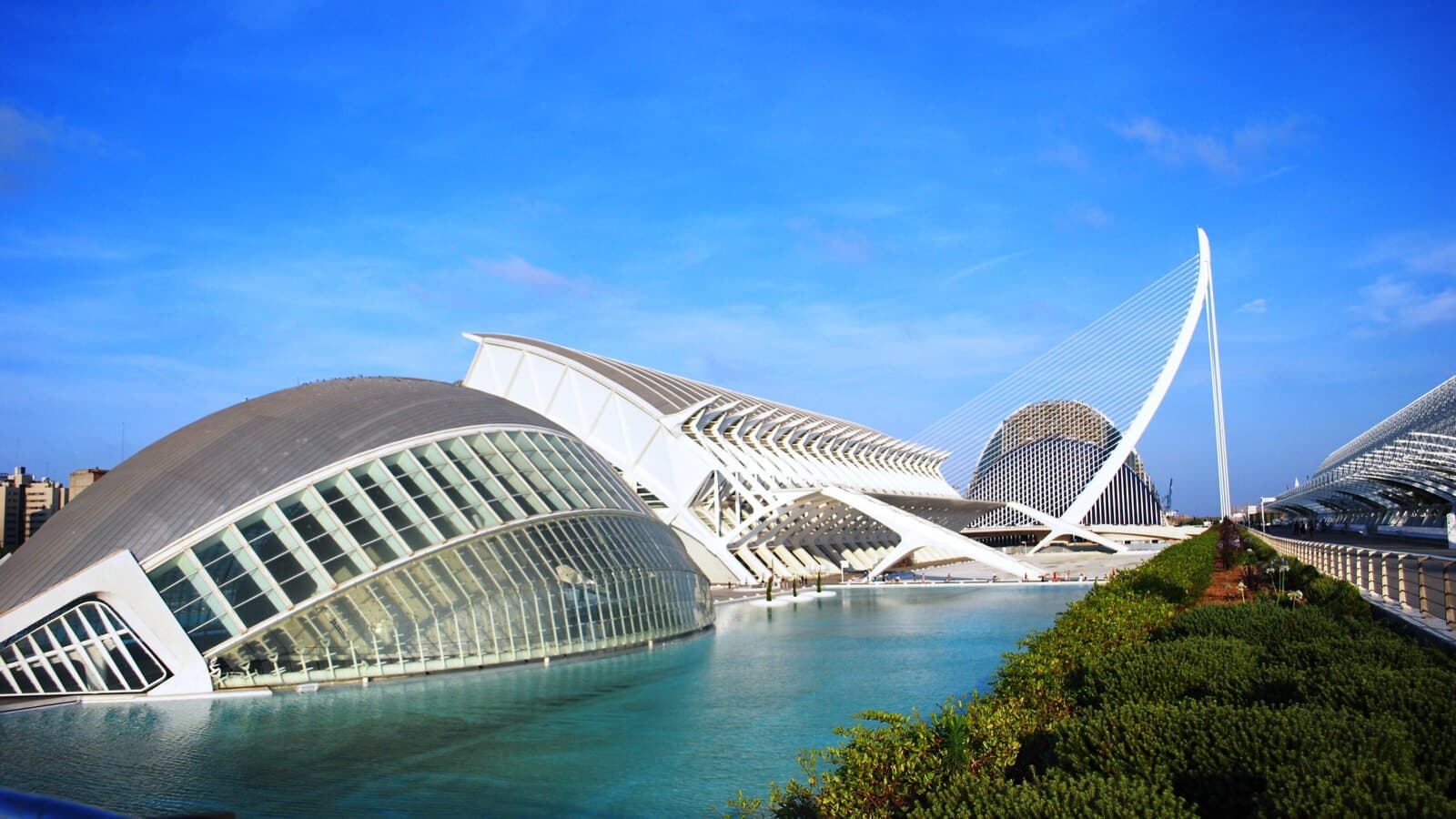
Photograph: Maribelle71, via Wikimedia Commons, licensed under CC BY 2.0. Original file.

If you have three days in Valencia, spend one in the old town, one on the Turia and the Cabanyal, and one in the Albufera. That order gets you the historic city, the way people actually live in it, and the wetland the city grew out of, and it leaves the City of Arts and Sciences as a half-day you can slot anywhere. This list is ordered the same way, because most people reading it are not only sightseeing. They are working out whether they could live here, and some of Valencia's best places tell you far more about that than others.
What is worth seeing in Valencia's old town?Link to this section
Three buildings and two gates: La Lonja, the Mercat Central, the cathedral, and the Serranos and Quart towers. Ciutat Vella is walkable end to end in half an hour, so this is an afternoon rather than a day.
La Lonja de la Seda, the silk exchange, was built between 1482 and 1548 and made a UNESCO World Heritage Site in 1996. The trading hall is a room of twisted stone columns rising into a vault, built to advertise that Valencia was rich. It takes twenty minutes to see and it is the single most beautiful interior in the city.
The Mercat Central faces it across the square. Built between 1914 and 1928, it is the largest fresh-produce market of its kind in Europe, with close to four hundred traders under an iron and glass roof. Go before eleven on a weekday if you want to see it working rather than photographed. If you are flat-hunting, this is also your most honest supermarket-price survey.
The cathedral is a stack of five centuries in one building, with a Gothic core, a baroque front, and the Micalet bell tower you can climb for the roofline. The chapel to the left of the entrance holds the cup the Vatican accepts as a candidate for the Holy Grail. Whatever you make of that, the room is quiet and free of queues in a way the Sagrada Família has not been in decades.
Two city gates survive from the medieval walls, the Torres de Serranos and the Torres de Quart, and both can be climbed. Serranos gives you the better view over the Turia.
Why does Valencia have a park where its river should be?Link to this section
Because the river flooded the city in 1957, the government diverted it around the south, and residents spent the 1970s stopping a motorway being built in the empty channel. The story behind the park is the story of the city.
In October 1957 the Turia flooded and put three-quarters of Valencia under water. The government's response was to divert the river around the south of the city altogether, in works finished in 1969, leaving a dry channel curving through the middle of town. A motorway was proposed for it. Residents campaigned against that through the 1970s under the slogan that the river was theirs and they wanted it green, and they won.
What you get is a sunken linear park, more than nine kilometres of it, crossed by old stone bridges, with football pitches, running tracks, palm groves and a bike route that gets you across the city faster than any road. Walk or cycle a section of it, ideally the stretch from the Torres de Serranos towards the Palau de la Música. If you visit Valencia and skip the Turia, you have missed the argument for the city.
At the western end sits the Bioparc, a zoo built without visible barriers, which is the best thing in the city to do with children under ten.
Is the City of Arts and Sciences worth paying for?Link to this section
Walking through it is free and worth it. Of the five buildings, only L'Oceanogràfic reliably repays a ticket on its own.
| Building | What it is | Worth the ticket? |
|---|---|---|
| L'Oceanogràfic | The largest aquarium in Europe | Yes, and give it a half-day |
| L'Hemisfèric | The planetarium and IMAX | Only if the programme suits you |
| Museu de les Ciències | A hands-on science museum aimed squarely at children | With children; otherwise no |
| Palau de les Arts | The opera house | Check the programme rather than the exterior |
| L'Àgora | CaixaForum València since June 2022 | Consistently the most interesting art in the city |
At the eastern end of the Turia, the channel ends in Santiago Calatrava's white complex, which is the picture on every article about Valencia including, probably, the one that sent you here. On a hot day the shallow pools and the shade under the Umbracle make it the most pleasant place in Valencia to do nothing.
Which Valencia beach should you go to?Link to this section
Las Arenas and the Malvarrosa for a broad urban beach twenty minutes out on tram 4 or 6, the Patacona for something quieter, and El Saler if you want dunes and pine instead of a promenade.
The Cabanyal is the old fishermen's quarter by the sea, a grid of low houses with tiled façades that spent decades slated for demolition and was saved. It is now the most-argued-about neighbourhood in the city, gentrifying visibly, and one of the few places in Spain where you can eat well two streets from a working port.
Behind it run the city beaches, Las Arenas and the Malvarrosa, which are broad, clean and genuinely urban: tram 4 or 6 gets you there from the centre in about twenty minutes. Keep walking north across the boundary into Alboraia and you reach the Patacona, quieter and lined with the beach flats that half of Valencia's foreign residents daydream about.
If you want a wilder beach, the Devesa and El Saler are south of the city inside the Albufera park, backed by dunes and pine rather than promenade.
Ruzafa, at street levelLink to this section
Russafa in Valencian, Ruzafa in Spanish, and the place most visitors mean when they say Valencia felt young to them. It sits just south of the railway station, it has its own covered market, and its cross-streets carry the highest density of good bars, independent shops and small restaurants in the city.
It is also the neighbourhood that has changed fastest and priced up hardest, which is a thing to notice rather than a thing to enjoy. Spend an evening here; then walk twenty minutes to Benimaclet and notice the difference in what a beer costs and who is drinking it. That comparison is worth more to a prospective resident than any listicle, and we have written it out properly in eight Valencia neighbourhoods, honestly compared.
Where does paella actually come from?Link to this section
The Albufera, a freshwater lagoon behind a sandbar ten kilometres south of the city, ringed by rice paddies. Not the seafood version sold on the beachfront: the original is rabbit, chicken and beans, cooked over orange wood.
Take the number 24 bus from near the Estació del Nord, not the 25, which goes elsewhere. It reaches El Palmar, the village on the lagoon, in under an hour. Eat lunch there, then take a flat-bottomed boat out for the last hour of daylight, when the water goes the colour the paintings say it does. This is the best half-day in the province and the cheapest thing on this list.
What has actually opened in Valencia in 2026?Link to this section
Less than the coverage suggests. Valencia's museum map is genuinely changing, and the reporting has run ahead of the openings.
The Hispanic Society of America has chosen Valencia for its first venue outside New York, bringing more than two hundred works by Joaquín Sorolla, the Valencian painter whose subject was this coast's light. The permanent home is to be the Palacio de las Comunicaciones on the town-hall square, which is still being refurbished. In the meantime the collection's home is the Museu de la Ciutat. A separate space for the sculptor Manolo Valdés is being fitted out through 2026, with its opening announced for 2027.
Check both before you plan around them. An article that tells you they are open is an article written from a press release.
The other 2026 event has already happened: on 12 August the total solar eclipse crossed Spain and Valencia sat under totality for about a minute, the first from the Spanish mainland since 1905. Spain gets two more, and the 2027 one across Andalusia is the better of them.
The modernista city, which most visitors missLink to this section
Valencia got rich twice, and the second time was around 1900, on oranges. The money went into buildings, and they are scattered across the centre rather than gathered into a district.
The Mercat de Colón, finished in 1916, is the showpiece: a market hall of brick, iron and ceramic that holds cafés now instead of stalls. Ten minutes away, the Estació del Nord is a working railway station decorated in orange-blossom mosaic, and it is worth walking into even if you are not catching a train.
For painting, the Museu de Belles Arts on the far side of the Turia holds the best collection in the city and charges nothing to enter, which makes the fact that it is usually empty slightly absurd.
Do you need a car in Valencia?Link to this section
No, and nothing on this list needs a taxi either.
The centre is walkable, the metro and tram network covers the rest, and lines 3 and 5 both run to the airport, so a visit can begin and end without a car. Trams 4 and 6 reach the Cabanyal and the beach. The one thing to sort out on arrival is a travel card rather than single tickets, because the fare structure rewards it heavily.
The better move is a bike. The city is flat, the Turia is a traffic-free corridor across the middle of it, and the bike-lane network reaches the beach. On a bike, the old town, the Turia, the City of Arts and the sea are one afternoon rather than three.
When is the best time to visit Valencia?Link to this section
Late September to early December is the best window: warm, uncrowded, and the sea is still swimmable well into October. March to early June is nearly as good and busier.
If you can only come in March, come for Fallas, which runs from 1 to 19 March and has been UNESCO intangible cultural heritage since 2016. Enormous satirical sculptures go up in the streets and are burned on the last night, and there is a mascletà, a percussive daylight fireworks display, at two o'clock every afternoon in the town-hall square. It is louder than you are expecting, and there is nothing else like it in Europe. It is also the worst possible week to judge whether you could live in Valencia, because the city is not itself.
Avoid August unless you are here for the beach and nothing else. Locals leave, businesses close, and the heat is the one part of Valencia that no article oversells.
Once you have seen the city, the province is the next layer, and it is reachable on commuter trains for the price of a coffee. For what the city is like when the visit ends and the year begins, we wrote the honest version.
Thinking about more than a holiday? Our free eligibility check takes a minute and tells you which Spanish residence route your situation fits, if any does.