Where to live in Valencia: eight neighbourhoods, honestly compared
Plain Spain editorial team · · 10 min read
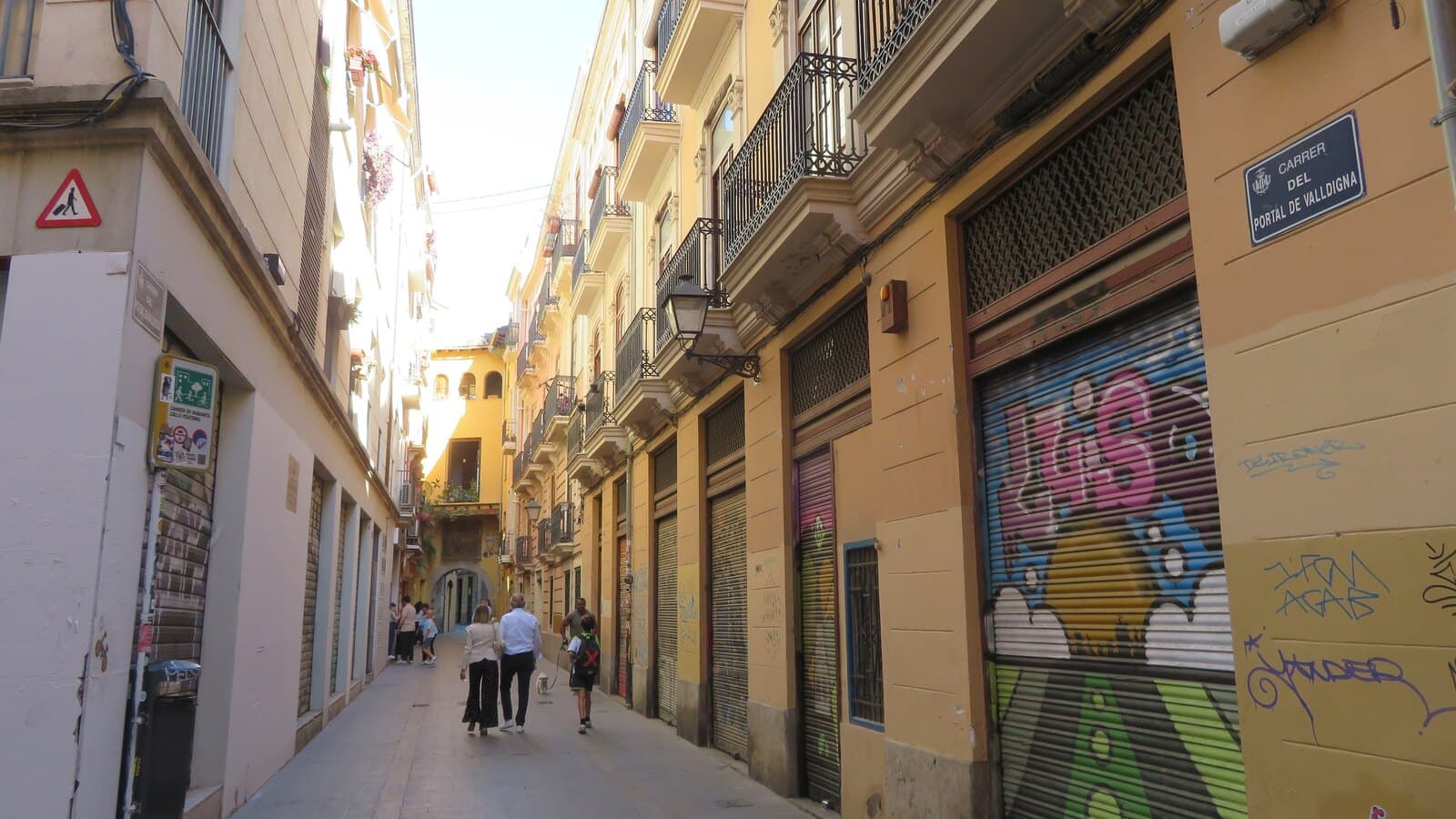
Photograph: Juan Emilio Prades Bel, via Wikimedia Commons, licensed under CC BY 4.0. Original file.
.jpg)
Most people arriving in Valencia pick Ruzafa, discover it is the loudest and dearest part of the city, and move within a year. The city is small enough that every neighbourhood below is within twenty-five minutes of every other one, so the choice is not about convenience. It is about noise, tourist density, whether you want a market or a supermarket, and whether you want the beach at the end of your street or at the end of a tram line.
Here are eight, from the ones everyone hears about to the ones people move to second.
| Neighbourhood | Who it suits | What you give up |
|---|---|---|
| Russafa | People who want the night out at the end of their street | Quiet, and the cheap end of the market |
| El Carmen | People who want to live inside the medieval city | Sleep, and windows that let any light in |
| La Seu, La Xerea and the rest of Ciutat Vella | People who want the centre without the noise | Choice: there are few long-term flats and they go fast |
| L'Eixample and the Gran Via | Families, and anyone buying space | Money, and a certain amount of excitement |
| El Cabanyal | People who want the sea and can live beside an argument | Consistency, street by street |
| La Patacona | People who want the beach at the end of the street | Half an hour to the centre, and August to the holidaymakers |
| Benimaclet | People who want a village inside a city, cheaply | Beauty, because much of it is 1970s blocks |
| Campanar | Families who want a modern flat and quiet | Atmosphere, and any sense of being in the old city |
Two notes before the list. We give no rent figures, because a number written in August is wrong by Christmas in this market and a wrong number is worse than none; the comparisons below are relative, and relative holds. And the difference between neighbourhoods here is smaller than the difference between two flats in the same street, because the variables that will actually govern your life are which way the flat faces, whether it has air conditioning, and which floor it is on.
Who should live in Russafa?Link to this section
People who want to walk out of the door into a night out, and who are here for a year or two rather than a decade.
Russafa sits immediately south of the main railway station, and it is the neighbourhood most foreigners hear about first. Its cross-streets hold the highest concentration of bars, small restaurants and independent shops in the city, along with its own covered market, and it is genuinely good at that.
The costs are exactly what you would predict. It is at the expensive end of the city, it has changed faster than anywhere else in Valencia, and a flat on one of the bar streets is loud until two in the morning at weekends. If you like Russafa, look at its quieter southern and eastern edges rather than the middle, where you get the same five-minute walk without the volume.
What is living in El Carmen actually like?Link to this section
Beautiful, central and loud. You live inside the medieval city and you trade quiet for it.
El Carmen is the north-western quarter of the old town, between the two surviving city gates, and it is the most photogenic part of Valencia. It is also where the tourist flats concentrate, where the nightlife is loudest, and where the buildings are oldest, which in practice means small windows, awkward stairs and heating that was never installed.
Live here for the streets. Do not live here if you work early, and read a rental contract carefully for what the building next door is licensed as.
Where in the old town is it quiet?Link to this section
East of the cathedral, in La Seu and La Xerea, which are residential and full of the sort of building that has a courtyard.
The old town is not one place. La Seu and La Xerea, east of the cathedral, are quiet, residential and full of the sort of building that has a courtyard. Sant Francesc, around the town-hall square, is the formal city and gets busy by day and empty by night. El Mercat, around the market and the silk exchange, is the middle ground.
These streets are the least-discussed good answer in Valencia: central, calm, and far less foreign than El Carmen. The catch is supply. There are not many long-term flats and they go fast.
Is L'Eixample worth what it costs?Link to this section
If you want space and quiet within a short walk of everything, yes. It is Valencia's most expensive residential district and it delivers what it charges for.
It is the nineteenth-century grid between Russafa and the Turia, and the Gran Via Marqués del Túria is its spine: wide, tree-lined, quiet, with large flats in solid buildings. The streets around the Mercat de Colón hold the best shopping in the city.
This is the safe and slightly dull choice, and it is genuinely comfortable. You pay for it, and what you buy is a large flat, a short walk to everything, and neighbours who have lived there for thirty years.
Should you live in the Cabanyal?Link to this section
If you want the sea and can live in a neighbourhood that is mid-argument about its own future, yes.
The Cabanyal is the old fishermen's quarter, a low grid of tiled houses set back from the beach, which spent decades under a demolition plan and survived it. It is now the most contested neighbourhood in Valencia: restored houses beside boarded ones, new cafés beside bars that have been there since the port was the port, and an active local debate about who the restoration is for.
You get the beach five minutes' walk away, tram 4 or 6 into the centre in about twenty minutes, and the best fish in the city. You also get blocks that are still rough, a summer that fills with visitors, and prices rising faster than anywhere except Russafa. Walk the specific streets before you sign anything, at night as well as by day.
Where can you live on the beach itself?Link to this section
La Patacona, which is not technically Valencia at all. It is the seafront strip of Alboraia, immediately north of the Malvarrosa across the city boundary, and it is a wall of modern flats facing the sand with a promenade of restaurants below them. Everything about it is newer than the rest of this list: newer buildings, better insulation, lifts, terraces.
The trade-off is that you are half an hour from the centre by metro line 3 to Alboraia plus a walk, or a pleasant twenty-five-minute cycle along the seafront, and that the neighbourhood is residential in the way suburbs are. In August you share it with everyone else's holiday. In February it is the best value on this list.
Where is the best value left in Valencia?Link to this section
Benimaclet: a village the city grew around, with both universities next door and the best transport position in the city.
Benimaclet was a separate village until the city grew around it, and it still has the square, the church and the low houses to prove it. Both universities are next door, so it is young, cheap by Valencia standards, and full of bars where nobody is a tourist. Its market square holds the neighbourhood together in a way the newer districts cannot replicate.
It has the best transport position in the city, sitting where the metro lines and the beach trams cross, which puts the centre and the sea both within about fifteen minutes. What you give up is beauty. Much of Benimaclet is 1970s blocks, and it looks like it.
Where do families with young children end up?Link to this section
In Campanar and the newer districts nearby, if they want a modern flat and quiet and do not mind being off the tourist map entirely.
Campanar sits north-west of the centre at the western end of the Turia park, mixing an old village core with a large stock of modern flats. It has its own metro stop on line 1, a lot of green space, and almost no visitors. Families who arrive with children and no interest in nightlife often end up here or in the newer districts nearby.
It is the least atmospheric neighbourhood on this list and the most practical. If your priority is a three-bedroom flat with a lift, a park at the end of the street and neighbours who are also raising children, this is the answer.
Is it worth living outside the city boundary?Link to this section
To the north, often. To the south and west, only after you have asked one specific question.
Valencia's metropolitan area is large, and some of the best value sits outside the city limits. Two different situations get confused with each other.
To the north and north-west, towns like Alboraia, Godella, Rocafort and Puçol are ordinary commuter territory: houses with gardens, good metro links into the centre, and a strong pull for families who want a school run on foot. This is where a lot of long-settled foreign residents live, and the metro makes it work.
To the south and west, the picture is different, and it is the one part of choosing a home here where you should ask a specific question. The flood of 29 October 2024 tore through the towns along the Poyo ravine, Paiporta, Picanya, Catarroja, Massanassa and Alfafar among them, and killed more than two hundred people. Reconstruction has moved at very different speeds from street to street. Metrovalencia's southern branch was rebuilt and reopened in full on 27 June 2025. The commuter rail has not caught up: the C-3 line beyond Buñol, towards Requena and Utiel, was still running on replacement buses two years on, with no restoration date announced.
None of that makes these towns a bad place to live, and many of them are recovering well. It does mean that a rental advertised on its train connection needs that connection checked against today's timetable rather than the map on the wall.
What should you check in the flat itself?Link to this section
Four things: which way it faces, whether its air conditioning is legal, whether it has any heating, and which floor it is on. The single biggest determinant of how much you enjoy Valencia is not the district, it is the flat.
Which way it faces. A west-facing flat takes the afternoon sun full on, and in July and August that is the difference between a home and an oven. South and east are the good answers. Ask, and ask again at the viewing with a compass on your phone.
Air conditioning, and whether it is legal. Many older buildings restrict external units. A flat advertised with air conditioning that has no unit installed is a flat where you will spend the first summer arguing with the residents' association.
Heating, or the absence of it. Most Valencian flats have none. Two weeks in January will make you care about this more than you expect, and a portable heater on Spanish electricity prices is an expensive answer.
The floor and the lift. Old buildings here are often four or five storeys with no lift, and the entresuelo and first floor are dark. If you are viewing in October it will not occur to you to mind. Mind anyway.
Two contract points worth knowing. Long-term residential leases in Spain give the tenant substantial rights to extend, so a contrato de arrendamiento de vivienda is very different from a short-term or seasonal contract that looks nearly identical on the page. And the standard deposit is set by law, while anything an agency asks for on top of it is negotiable more often than it is presented as being.
How do you actually choose?Link to this section
Rank three things in order, sea or centre, how much noise you can take, and how long you are staying, and the shortlist writes itself.
Sea or centre. You cannot have both in one address. The Cabanyal and the Patacona put you at the beach and twenty to thirty minutes from the old town. The Eixample and Ciutat Vella reverse that. Benimaclet is the only real compromise.
Noise tolerance. Russafa and El Carmen are loud at weekends by design. La Seu, the Eixample and Campanar are not.
How long you are staying. For a first year, rent somewhere central and slightly over-serviced, learn the city, then move. Almost everyone we speak to who has lived here three years is in a different neighbourhood from the one they arrived in, and the ones who are happiest treated the first flat as a deposit on the decision rather than the decision.
One practical warning that applies everywhere. Valencia's long-term rental market is tight, good flats go within a day or two, and agencies expect your documents ready at the viewing. Trying to sign a year's lease from another country, sight unseen, is how people end up paying above the market for the flat nobody local wanted. Come for two weeks, stay somewhere temporary, and look in person.
For what the year that follows actually feels like, we wrote the honest version of living here. If you are still deciding between cities rather than streets, Valencia against Barcelona is the comparison most people are really making.
Before you sign anything for longer than a tourist stay, check which residence route fits you. Our free eligibility check takes about a minute and gives you a straight answer, including when the answer is no.