Valencia or Barcelona: choosing your base for a move to Spain
Plain Spain editorial team · · 10 min read
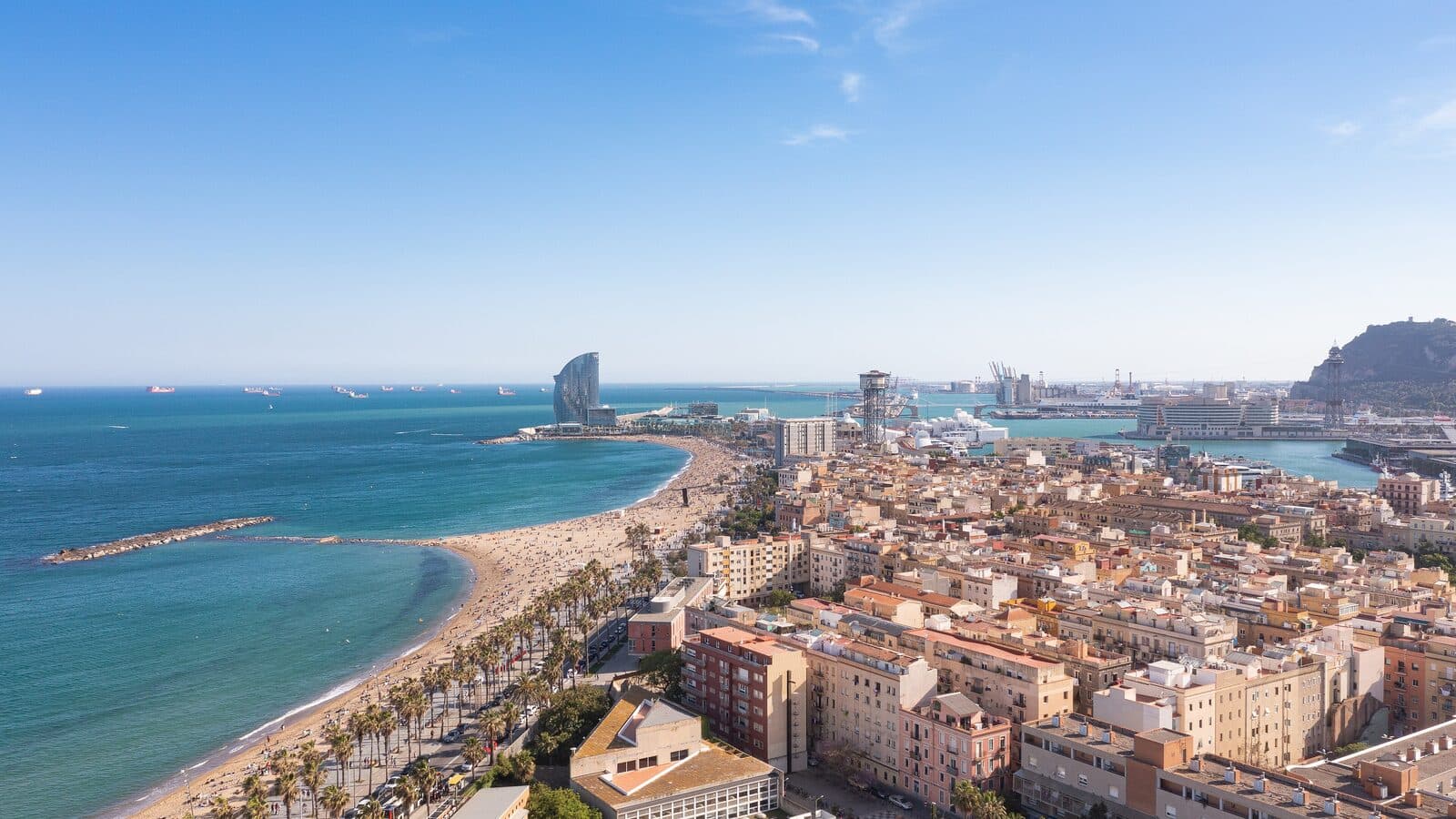
Photograph: dronepicr, via Wikimedia Commons, licensed under CC BY 2.0. Original file.
.jpg)
Short version. Choose Barcelona if your work, your industry or your ambition needs a genuinely international city and you can absorb the cost and the crowds. Choose Valencia if you want a Mediterranean city you can afford, cross by bike and actually settle into, and you are willing to give up some scale to get it. Almost everyone we help decide is really choosing between those two sentences.
The rest of this is what sits behind them, because the differences that matter after year one are not the ones that show up on a weekend visit.
| What decides it | Valencia | Barcelona |
|---|---|---|
| Size | Around 800,000 in the city, under two million around it | Around 1.5 million in the city, some 5.5 million around it |
| Cost | Cheaper across the board, and no longer cheap in absolute terms | Higher, and unevenly so: rent punishes, daily life much less |
| Housing market | No cap, and good long-term flats gone within a day or two | Rent-capped since March 2024, with more than ten thousand tourist flats returning to it in November 2028 |
| Tourist pressure | Concentrated in the old town and the beachfront | City-wide, and openly contested since 2024 |
| Schooling language | A family vote at each school, year group by year group | Substantially Catalan, with a quarter of hours in Spanish |
| Flying home | Around a hundred non-stop destinations; long-haul via a connection | A major European hub, intercontinental routes included |
| Beaches | Wide, urban, and twenty minutes away on a tram | Narrow, crowded, and a long way from most homes |
| What makes up for it | Flat and cyclable end to end | The Pyrenees at two hours, the Costa Brava at one |
How big is the difference in scale?Link to this section
Barcelona is a metropolis and Valencia is a city you can cycle across in half an hour. Roughly one and a half million people live in the city and something like five and a half million in its wider area, and it behaves accordingly: a dense centre, real traffic, a metro you rely on, districts you might not visit for months.
Valencia is a city of around 800,000 with a metropolitan area under two million. You can cycle across it in half an hour. Within about a month here you will keep bumping into people you know, which is either the best or the worst thing about the place depending on what you came for.
That difference cascades. Barcelona has more of everything: jobs, concerts, restaurants, direct flights, specialists, weirdness. Valencia has enough of most of it and far less friction getting to any of it.
Is Valencia cheaper than Barcelona?Link to this section
Across the board, and the gap is widest in housing. That is the single most reliable statement anyone can make about the pair, and it holds in every index we have looked at.
Two things complicate it. First, Valencia is no longer cheap in absolute terms. It has moved from bargain to mid-priced Spanish city in about five years, and the neighbourhoods foreign arrivals hear about first have risen the fastest. The Valencia that people describe from a 2019 visit is not the one you would be renting in.
Second, Barcelona's cost is not evenly distributed. Rent and anything tourist-facing are punishing; the metro, public healthcare, produce markets and neighbourhood restaurants are not much more than Valencia's. If you live like a resident rather than a visitor, the gap narrows, though it never closes.
Which city is harder to find a flat in?Link to this section
Both are hard, in different ways: Barcelona's market is capped and scarce, and Valencia's is uncapped and has simply run ahead of supply. The difference is worth understanding before you choose.
Barcelona's rental market is capped. Since March 2024, most of the metropolitan area sits inside Catalonia's designated pressure zones, where rents on new contracts are limited by a reference index. The measurable effect has been that advertised rents in regulated municipalities stopped rising the way they did elsewhere in Catalonia, while supply of long-term contracts fell and demand for each listing climbed. Separately, the city has decided not to renew any of its licensed tourist flats when they expire in November 2028, which will return more than ten thousand properties to the residential market at once. That is a genuinely large intervention and nobody yet knows what it does to prices.
Valencia has no cap and a market that has simply run ahead of supply. Good long-term flats go within a day or two, agencies expect your documents at the viewing, and the practical effect is the same as Barcelona's from the tenant's side: you must be in the city, ready, to compete.
The honest summary is that in Barcelona you are fighting scarcity created partly by regulation and partly by tourism, and in Valencia you are fighting scarcity created by a lot of people discovering the same city at once.
How bad is the tourist pressure in each city?Link to this section
Barcelona has been openly at war with its own visitor numbers since 2024. Valencia has the same problem at a fraction of the scale, and only in two places. There have been marches with placards reading that one more tourist means one fewer resident, tourist taxes raised again in April 2026 to among the highest in Europe, cruise-passenger charges going the same way, and the 2028 decision on holiday flats. Residents of the Gothic Quarter, the Barceloneta and increasingly Gràcia will tell you what living inside that feels like, and it is not a small effect on daily life.
Valencia has the same problem at a fraction of the scale and concentrated in two places: the old town and the beachfront. Fifteen minutes inland the city is residential and unbothered. The direction of travel is the same as Barcelona's, and locals are starting to say so, but the current experience is not comparable.
If you want the tourist-facing version of the Catalan capital, we wrote Barcelona beyond the postcard, which is largely about how to see it without adding to the problem.
Do you need Catalan, or Valencian?Link to this section
In Barcelona, Catalan is the default medium of state schooling and the ceiling on how far into local life you get without it. In Valencia the school language is decided by a vote, and there is mostly no such ceiling.
This is where people get the comparison wrong, and it matters most if you have children.
In Catalonia, Catalan is the ordinary language of public administration and, in schools, the default medium of instruction. Courts have required that at least a quarter of classroom hours be delivered in Spanish, and that requirement has been litigated for years. A child entering a state school in Barcelona will be educated substantially in Catalan.
In the Valencian Community, Valencian and Spanish are both official, and since a 2024 education law each school holds a family vote, year group by year group, on which is the main language of instruction. In the first round for the 2025-26 year, families in the city of Valencia chose Spanish by more than sixty per cent, while the region as a whole split almost exactly down the middle. So the language your child is taught in here is a school-level, changeable answer, not a regional one.
For an adult, both cities work in Spanish and both reward learning the local language. The asymmetry is that in Barcelona, not learning Catalan puts a ceiling on how far into local life you get, and in Valencia it mostly does not.
Which city is better connected?Link to this section
Barcelona, decisively, and it is the strongest practical argument for it. El Prat is a major European hub with intercontinental routes; if you fly home three times a year to somewhere that is not in Europe, that is a real, repeated saving in money and hours.
Valencia's airport is small but serious: around a hundred non-stop destinations across thirty countries, most of Europe covered directly, and it is roughly half an hour from the city centre by metro. Long-haul almost always means a connection somewhere.
By land they are about three hours apart by train, and both connect to Madrid on high-speed rail, Valencia in a little over an hour and a half.
Where is it easier to make friends?Link to this section
Easier on arrival in Barcelona, and easier to integrate in Valencia.
Barcelona has one of the largest foreign populations in Europe, which means a ready-made social life on arrival in almost any language, professional networks in most industries, and the specific risk that you never leave the anglophone bubble because you never have to.
Valencia's foreign community is large enough that you will not be lonely and small enough that it overlaps constantly with the Spanish city around it. People here integrate faster, partly because the city is small and partly because there is no complete parallel society to join.
Which one has the better beaches?Link to this section
Valencia, and it is not close. Barcelona's beaches are the city's weakest asset: narrow, crowded and a long way from most of where people live. Its compensation is that the Pyrenees are two hours away and the Costa Brava is one.
Valencia's beaches are wide, urban and reachable by tram, and there is a freshwater lagoon and rice country ten kilometres to the south. Its compensation for having no mountains is that everything else is flat and cyclable.
Summers are hot in both. Valencia's August is hotter and heavier, and it empties out. Barcelona's is more humid than people expect and full of visitors.
How do you settle it in two weeks?Link to this section
Rent somewhere residential in each city for a week and live a normal week in it, rather than visiting. A weekend in each will tell you which you prefer; it will not tell you which you should live in.
So: short-term in each, in a residential neighbourhood rather than the centre, and a week of ordinary life: shop, cook, work your actual hours, take the transport you would take. Both cities are delightful to a visitor. The question is which one is tolerable on a wet Tuesday in February with a deadline.
Go in the wrong month if you can. August in Valencia and August in Barcelona decide whether you can live in either, and both are misrepresented by every guide written from a spring visit, this one included.
Test the commute you would actually have, at the hour you would have it. In Barcelona this is a real variable. In Valencia it usually is not, and discovering that for yourself tells you more than a week of sightseeing will.
Finally, ask one local in each city what has got worse in the last five years. In Barcelona you will hear about tourism and rent. In Valencia you will hear about rent and, increasingly, tourism. How strongly they say it is the clearest measure of the gap between the two cities we have found.
Is healthcare or admin a reason to pick one?Link to this section
No. Both regions run good public health services, private cover in either is cheap by international standards, and this is not the line on which you should decide.
Where they differ is administrative throughput. Getting an appointment for a residence card, a tax number or a town-hall registration is slow in both, and worse in Barcelona simply because more people are competing for the same slots. Neither is a dealbreaker. Both will cost you more weeks than you have budgeted.
Choose Barcelona ifLink to this section
You need a large international job market, or an industry that only clusters in big cities. You fly intercontinentally often enough that a hub airport is worth paying for. You want a cultural calendar that never thins out, and mountains and city in the same weekend. And you either have the budget to absorb the housing market or a contract that pays a Barcelona salary.
Choose Valencia ifLink to this section
Your income comes from outside Spain and follows you, and you would like to be able to afford the city you live in. You would rather be somewhere that still works for the people who live there than somewhere famous. You are moving with children and would rather the language of their schooling be a question with a local answer. And you want the beach to be part of an ordinary week rather than an outing.
And if neither is obviously rightLink to this section
Then the shortlist is longer than two. Seville, Málaga, Bilbao, Alicante and Madrid each answer a different version of this question, and we have laid all seven out side by side in where in Spain you should actually live.
If Valencia is winning and you want the unvarnished version before you commit, a year here, honestly is the piece to read next.
Whichever city wins, the residence route is what makes it possible, and the two Spanish routes suit very different finances. Our free eligibility check takes about a minute and tells you which one fits, or that neither does.