Best places to visit in Seville, and when to go
Plain Spain editorial team · · 9 min read
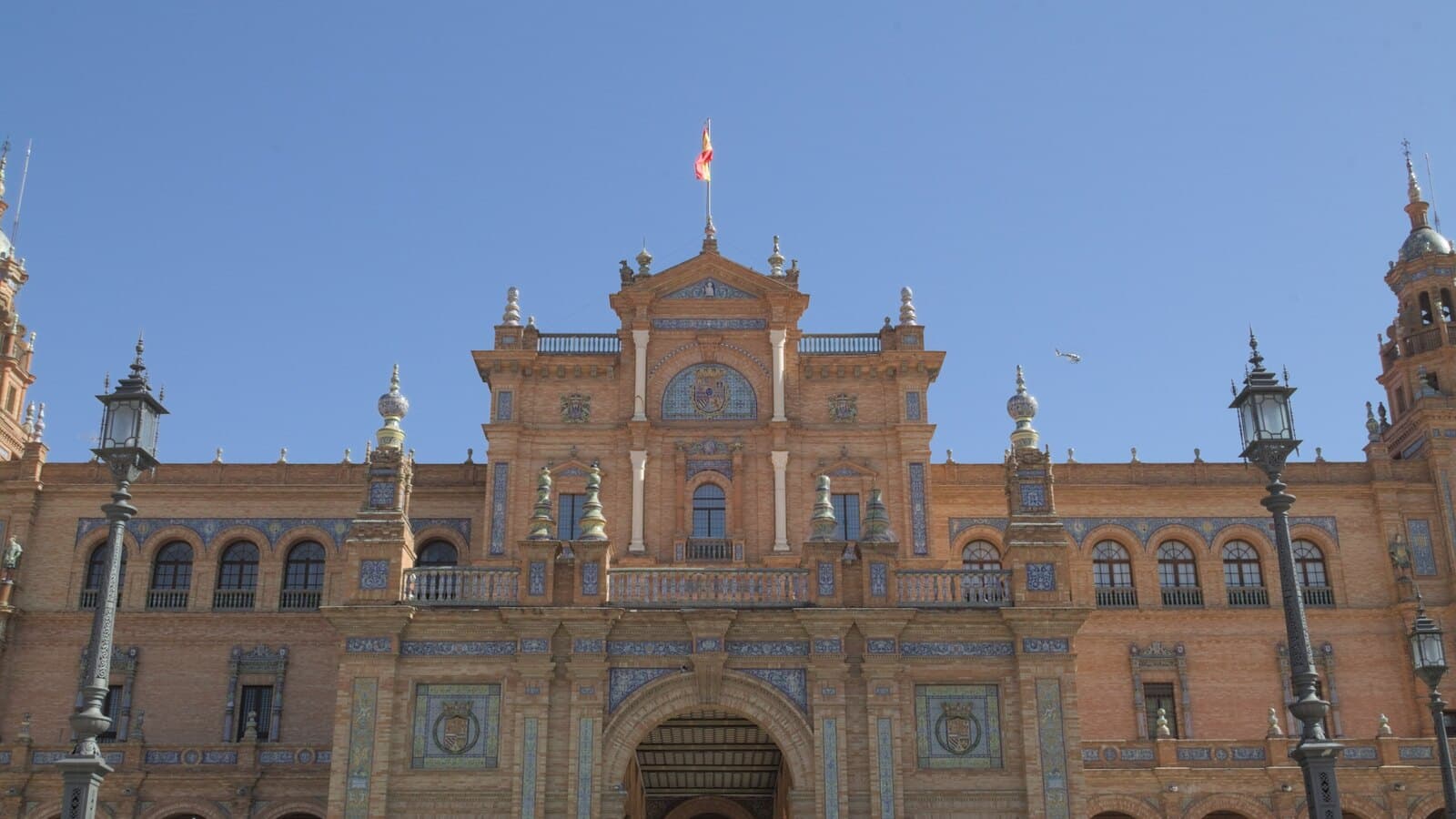
Photograph: o_andras, via Wikimedia Commons, licensed under CC BY-SA 4.0. Original file.

Seville's essentials are small in number and close together: the Real Alcázar, the cathedral with the Giralda beside it, the Plaza de España, and an evening in Triana across the river. Two days covers them. What decides whether you enjoy it is the calendar, not the list. Come between March and May or in October and November and it is one of the most pleasant cities in Europe. Come in July or August and you are visiting a furnace with beautiful architecture in it.
That is not a figure of speech. The city's record is 46.6°C, set on 23 July 1995, and the high thirties into the low forties are ordinary for July and August. Residents adapt by reversing the day: out early, indoors and shuttered from two until seven, then a life that runs until well past midnight. If you visit in summer, adopt that timetable rather than fighting it.
Is the Real Alcázar worth booking ahead?Link to this section
It is the one ticket in Seville to buy before you fly. Entry is limited by the hour, slots go early in spring and autumn, and turning up on the day in April is how people miss it entirely. Go at opening if you can, and walk the gardens first while everyone else queues for the palace.
It earns that trouble. This is the best building in the city and one of the best in Spain: a royal palace still in use, built and rebuilt across centuries, whose heart is the fourteenth-century Mudéjar palace of Pedro I. Plasterwork, tiled dados, and courtyards designed around water and shade by people who understood this climate better than any air-conditioning engineer. The gardens behind it are large enough to lose the crowd in, and worth as much time as the rooms.
What is inside Seville's cathedral?Link to this section
The largest Gothic interior in the world, Columbus's tomb carried by four kings, and an altarpiece that took most of a lifetime to carve. It was built on the footprint of the mosque it replaced, and it feels less like a church than like a covered canyon, at a scale that is genuinely difficult to photograph.
The Giralda beside it was the mosque's minaret before it became a bell tower, and you climb it by a series of ramps rather than stairs, because they were built for a man on horseback. That makes it one of the easiest great views in Spain to reach. What you see from the top explains the city's shape better than any map: the river, the flat plain around it, and the old town packed tight below you.
The Patio de los Naranjos, the orange courtyard from the original mosque, is where you should stand for a moment to see the two buildings layered on each other.
Plaza de España and the parkLink to this section
Built for the 1929 exhibition, and one of the few grand set pieces in Spain that is genuinely as good as its pictures: a semicircle of brick and tiled alcoves, one for each Spanish province, wrapped around a canal you can row on. It is free and it is open air, which makes it the best thing to do on your first evening.
Behind it, the Parque de María Luisa is the city's shade. On a hot day it is a functional necessity rather than a sight, and the two museums at its far end are quiet, cheap and rarely busy.
Where do you find real flamenco in Seville?Link to this section
Across the river in Triana, at a small peña or a late set in a modest venue, where the audience is mostly local and the singing is the point rather than the costume. Ignore the dinner shows in the centre; they are priced for a coach party and paced for one.
Cross the bridge for the rest of it too. Triana was the sailors' and potters' quarter, and it is still where the ceramics come from, still proud of being separate. The market inside the old castle walls is a working one with bars along its edges. Calle Betis, facing back across the water, has the best view in Seville at sunset, and knows it.
Which Seville sights do most visitors miss?Link to this section
Four, all of them within twenty minutes' walk of the cathedral: Casa de Pilatos, the Palacio de las Dueñas, Las Setas and the Alameda de Hércules.
Casa de Pilatos is a private Andalusian palace with tiled courtyards to rival parts of the Alcázar, and a fraction of the visitors. If the Alcázar is sold out, this is not a consolation prize; it is a genuine alternative.
Palacio de las Dueñas is the house of the Alba family, opened to the public, and it feels lived in rather than curated, which is rarer than it sounds.
Las Setas, the enormous timber structure over Plaza de la Encarnación, divides people. The walkway on top gives you the whole city at the level of the rooftops, and the Roman remains in the basement are the reason the square was dug up in the first place.
Alameda de Hércules is where Seville drinks when it is not performing for anyone. Wide, scruffy, full of terraces and families and dogs, and about as far from the postcard as you can get in twenty minutes on foot.
How does tapas work in Seville?Link to this section
It is a method rather than a menu: you order one or two things at the bar, standing, eat them, pay, and move on to the next place. Sitting at a table costs more and slows the evening down, which is the opposite of the point. Bar staff keep your total chalked in front of you or in their head, and asking for the bill at the end of a round is normal rather than rude.
What to order in the heat: salmorejo, the thicker Cordoban cousin of gazpacho, and anything fried, because Andalusia fries fish better than anywhere else in Spain and is not embarrassed about it. Spinach with chickpeas is the dish people are surprised to remember afterwards. Sherry from nearby Jerez is the local wine, it is dry rather than sweet, and a cold glass of manzanilla with olives at six in the evening is one of the reasons people move here.
What is the best way to get around Seville?Link to this section
A bicycle, and it is not close. Seville built out a segregated cycle network from the mid-2000s, on flat ground, and turned itself into one of the more cyclable cities in Europe almost by decree. The public hire scheme is easy to use for a few days, and riding along the river at dusk is a better introduction to the city than any tour.
Otherwise, most of what you want is walkable: the old town is compact and mostly closed to through traffic, with one metro line and trams filling the gaps. Getting here is easy too: the high-speed line puts Seville around two and a half hours from Madrid, which is competitive with flying once you count the airport.
Which day trips from Seville are worth the fare?Link to this section
Three: Córdoba for the Mezquita, Cádiz for the Atlantic, and Itálica for the Romans.
| Trip out | Roughly, each way | Why you go |
|---|---|---|
| Córdoba | 45 minutes, high-speed train | The Mezquita, a forest of striped arches with a cathedral dropped into the middle |
| Cádiz | 1 hour 40, regional train | Atlantic beaches and a walkable old town, for when the inland heat has won |
| Itálica, at Santiponce | 30 minutes, city bus | A Roman city with an amphitheatre, and usually empty |
Of the three, Córdoba is the one to protect a whole day for: the Mezquita is the single most extraordinary interior in Spain, and it is worth arriving at opening, before the coaches. Cádiz is a salt-worn Atlantic port on a spit of land, and the only one of the three that will cool you down. Itálica's amphitheatre makes the point about how important this corner of Spain once was, and it fills up only when a television crew has been filming there.
Santa Cruz, and where to eat insteadLink to this section
The old Jewish quarter is beautiful and it is also the most concentrated tourist funnel in the city. Whitewashed lanes, orange trees, wrought iron and a menu board every fifteen metres. Walk it early in the morning, when it is quiet and the light is on the walls, and eat somewhere else. The good food starts one or two streets outside it, and the difference in both price and quality is obvious immediately.
When is the best time to visit Seville?Link to this section
March to May, or October and November. Outside those two windows the weather is making your decisions for you.
| When | What it is like | The catch |
|---|---|---|
| March to May | The best window: warm days, long evenings, everything open | Semana Santa and the Feria fill every bed in the city |
| June to September | High thirties into the low forties | Half the day happens indoors; the record here is 46.6°C |
| October and November | Warm days, cool evenings, no crowds | None worth naming, which is the argument for it |
| December to February | Mild, bright and cheap | Short days and short spells of grey |
The spring caveat is worth the detail. Semana Santa and the Feria de Abril transform the city and fill every bed in it: in 2027 Holy Week falls between 21 and 28 March, and the Feria follows from 13 to 18 April. Both are extraordinary and neither is a normal week, so book months ahead or come between them.
October and November are the quiet secret, with the city back to being itself. July and August are for people with no choice. If that is you, plan indoor mornings, a siesta you actually take, and evenings that start at nine. And nobody thinks of Seville in winter, which is precisely the argument for it.
What is Seville like to live in?Link to this section
Cheaper than Madrid or Barcelona, beautiful at street level rather than only in photographs, and hard on your Spanish in the way that eventually fixes it. Plenty of people who come for a long weekend leave wondering what it would cost to stay. The honest counterweights are the summer, which shapes half the year, and a local job market thinner than Madrid's or Barcelona's, so most foreign residents here earn from elsewhere.
We put it side by side with six other options in where in Spain you should actually live, and if the Andalusian coast is also on your list, Málaga makes a different case entirely.
If you are already thinking about stayingLink to this section
Staying past a tourist stamp means a residence permit, and which one depends on where your income comes from rather than which city you pick. It is worth knowing the answer before you start looking at flats, because the paperwork begins in your own country and takes longer than the flat hunt does.
Two minutes will tell you where you stand: check which Spanish visa fits.